When it comes to enclosing a terrace, two options dominate the market: glass curtains and traditional aluminium enclosures. Both systems have clear advantages, but choosing one over the other depends on your needs, how you will use the space and your budget. In this guide we compare both solutions to help you make the best decision.
What are glass curtains?
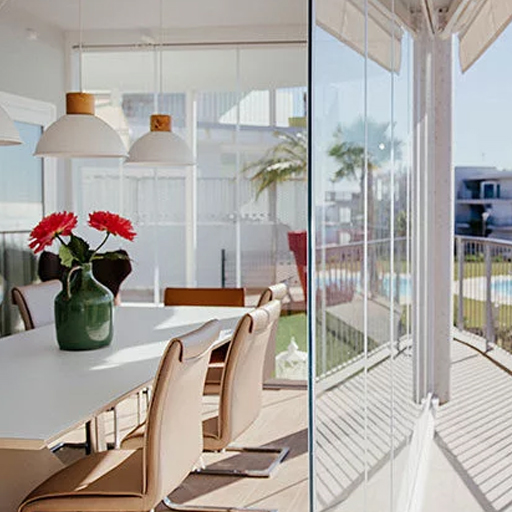
Glass curtains are a frameless glazing system. They consist of tempered glass panels that fold, stack or slide on upper and lower tracks, allowing you to open the space completely whenever you wish. The glass typically ranges from 8 to 12 mm thick, with tempered or laminated safety treatment.
Their main feature is total transparency: with no intermediate frames, they offer unobstructed views and a minimalist aesthetic that blends into any architecture. When fully open, the panels stack to one side, occupying just 15-20 cm in width.
What is an aluminium enclosure?
Aluminium enclosures use aluminium profiles with single or double glazing mounted in fixed frames and operable leaves (sliding, tilt-and-turn or folding). These are conventional enclosures where the aluminium provides structure and insulation, and the glass can be chambered (double or triple) to improve thermal efficiency.
They offer a hermetic seal that makes them ideal when you want to turn the terrace into a permanently habitable space with thermal and acoustic insulation equivalent to a residential window.
Head-to-head comparison
| Feature | Glass Curtain | Aluminium Enclosure |
|---|---|---|
| Aesthetics | Minimalist, no visible frames | Visible frames, conventional look |
| Views | Panoramic, unobstructed | Partially interrupted by profiles |
| Full opening | Yes (100% clear opening) | Partial (max. 50-70% depending on system) |
| Thermal insulation | Medium (reduces 8-12°C) | High (double glazing with thermal break) |
| Acoustic insulation | 25-32 dB reduction | 35-45 dB reduction |
| Weathertightness | Semi-hermetic | Fully hermetic |
| Maintenance | Low (glass cleaning) | Low (cleaning + hardware lubrication) |
| Indicative price | €250-400/m² | €200-500/m² |
| Planning permission | Generally not required | Yes, almost always |
Advantages of glass curtains
- Full opening: Folding the panels recovers 100% of the opening, impossible with a conventional aluminium enclosure. Ideal for hospitality and homes that want to maintain the open-terrace feel.
- Superior aesthetics: With no intermediate profiles, the visual is clean and elegant. The building's architecture is not altered, which also facilitates approval from the homeowners' association.
- More flexible regulations: As they are not considered a sealed enclosure in many municipalities, glass curtains usually require fewer planning procedures. They do not count as built surface area in most cases.
- Maximum natural light: By eliminating frames and mullions, natural light entry is considerably greater.
- Wind protection: C5-certified systems withstand winds of up to 160 km/h, protecting furniture and allowing terrace use even in strong breezes.
Advantages of aluminium enclosures
- Superior thermal insulation: With thermal break profiles and double or triple glazing, an aluminium enclosure can achieve very low thermal transmittance values (1.2-1.8 W/m²K), making it a climate-controlled habitable space.
- Total weathertightness: No water, air or dust. Well-installed aluminium enclosures are completely sealed, ideal for rainy climates or dusty areas.
- Greater acoustic insulation: If you live in a noisy area (road, town centre), aluminium enclosures with laminated glass and an air chamber can reduce noise by up to 45 dB, far superior to glass curtains.
- Security: Systems with multi-point locking and safety glass offer anti-intrusion resistance, something glass curtains do not provide to the same level.
When to choose glass curtains
Glass curtains are the best option when:
- You want to maintain the open-terrace feel and be able to open it completely in warm months.
- Aesthetics are a priority: you want panoramic views without frames.
- You need to comply with regulations that do not allow conventional enclosures.
- You have a hospitality business and need flexibility between indoor and outdoor.
- Your area's climate is mostly mild (like the Costa Blanca).
When to choose an aluminium enclosure
An aluminium enclosure is more suitable when:
- You want to turn the terrace into another room with climate control.
- You live in an area with cold winters and need real thermal insulation.
- External noise is a problem and you need maximum acoustic insulation.
- Anti-intrusion security is a priority (ground floors, isolated areas).
Can both systems be combined?
Yes, and it is more common than you might think. Many clients opt for glass curtains at the front (to maintain views and full opening) and aluminium enclosures on the sides (for added insulation). It is a hybrid solution that offers the best of both worlds.
At Cortina de Cristal, we have been installing both systems in Altea, Benidorm, Calpe and across the Costa Blanca for over 20 years. We advise you based on your space's characteristics, orientation, local climate and budget so you choose the optimal solution.
Need advice?
We help you choose between glass curtains and aluminium enclosures based on your specific case. No-obligation quote.
Request a Free Quote