One of the most frequent questions we receive is: "Can I enclose my terrace?" The short answer is yes, but it depends on the type of enclosure, your municipality's regulations and your homeowners' association agreements. In this article we break down everything you need to know about the current regulations in Spain in 2026 for legally enclosing terraces.
The Spanish Building Code (CTE)
The CTE (Codigo Tecnico de la Edificacion) is the main regulation governing construction in Spain. Regarding terrace enclosures, the relevant basic documents are:
- DB SE-AE (Structural Safety - Actions on Buildings): Defines the wind loads that any enclosure must withstand. A glazed enclosure must be calculated to resist the wind loads of its climatic zone. This is especially relevant in coastal areas like the Costa Blanca, where wind gusts can exceed 100 km/h.
- DB HE (Energy Saving): If the enclosure converts the terrace into habitable space, it must meet energy efficiency requirements. This mainly affects hermetic aluminium enclosures with double glazing.
- DB HS (Health): Establishes ventilation and water drainage requirements. The enclosure must not impede minimum ventilation of the dwelling or cause condensation problems.
Key fact: Glass curtains, being a non-hermetic system (they allow natural ventilation between panels), are generally not subject to DB HE requirements. This makes them the simplest option from a regulatory standpoint.
Types of enclosure and their legal implications
Not all enclosures are treated equally under the law. The most important classification is:
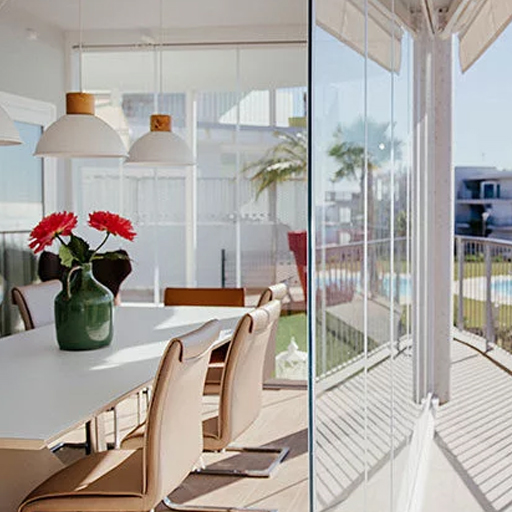
Glass Curtains
Non-hermetic system, no fixed profiles. Does not count as built surface area in most municipalities.
Less regulationSliding Enclosure
Aluminium profiles with glazing. Semi-hermetic. May count as surface area depending on municipality.
Medium regulationFixed Enclosure
Complete hermetic enclosure. Counts as built surface area. Requires building permit.
Maximum regulationHomeowners' association permissions
Under the Horizontal Property Law (Article 7), any modification that alters the building's facade requires approval from the homeowners' general meeting. This includes virtually any type of terrace enclosure.
What majority is needed?
- Unanimity: Required when the enclosure modifies common elements (facade) and changes the constitutive title. This is the strictest interpretation and the one many courts apply.
- 3/5 majority: Some jurists argue that 3/5 is sufficient if the enclosure does not affect the building's structure and does not modify the participation quota.
- Prior agreement in bylaws: If the community's bylaws already contemplate the possibility of enclosing terraces (with uniform aesthetic conditions), a new agreement may not be necessary.
Warning: Enclosing a terrace without community permission can lead to legal action to remove the enclosure, with costs borne by the owner. It is essential to obtain permission BEFORE installation.
Glass curtains: the special case
Recent case law from the Spanish Supreme Court has established that glass curtains, being a removable, transparent system that does not substantially alter the facade, receive more favourable treatment than conventional enclosures. Several Provincial Court rulings have found in favour of owners who installed glass curtains, arguing that:
- They do not significantly alter the building's exterior configuration.
- They are transparent and do not modify the facade's aesthetics.
- They are removable and reversible.
- They do not convert the terrace into enclosed habitable space.
Recommendation: Although case law is favourable, we always recommend obtaining the community's agreement before installation. It avoids conflicts and gives you full legal certainty.
Municipal licence
The type of licence required varies by municipality and enclosure type:
- Responsible declaration (Declaracion responsable): In many municipalities, glass curtains only require a responsible declaration (prior notification to the town hall). The procedure is simple and quick, generally 15-30 days.
- Minor works licence: Sliding aluminium enclosures usually require a minor works licence. They need a simplified technical project and the processing time is 1-3 months.
- Major works licence: Hermetic enclosures that count as built surface area may require a major works licence with an architect's project. This is the most complex case and can take 3-6 months.
Special case: Valencian Community
In the Valencian Community, the LOTUP (Land Planning, Urban Development and Landscape Law) establishes that works that do not alter urban planning parameters (built surface area, height, volume) can be processed as a responsible declaration. Glass curtains, as they do not count as built surface area, benefit from this simplified regime in most Alicante municipalities.
What if it is already enclosed without permission?
If your terrace already has an enclosure installed without the required permits, the situation depends on the time elapsed:
- Less than 4 years: The town hall can order demolition and restoration to the original state. It is advisable to legalise the situation as soon as possible.
- More than 4 years: In most autonomous communities, the planning infringement expires after 4 years (8 years in some regions). After this period, demolition cannot be ordered, but the work remains "out of planning" and cannot be legalised as such.
Important: The planning limitation period does NOT affect the homeowners' association's actions. The community can demand removal of the enclosure at any time if it was installed without authorisation, with no time limit.
Summary: steps to legally enclose your terrace
- Choose the right type of enclosure for your needs (glass curtains for minimum bureaucracy, aluminium for maximum insulation).
- Check your community's bylaws to see if they cover enclosures.
- Request authorisation from the homeowners' meeting (preferably in writing and recorded in the minutes).
- Process the licence or responsible declaration at your town hall.
- Hire a professional installer who complies with technical standards (CTE, CE marking, warranty).
At Cortina de Cristal we take care of advising you throughout the entire process: from choosing the system to processing permits. We have been installing enclosures in Altea, Benidorm, Calpe, Denia and across the Costa Blanca for over 20 years, and we know the local regulations of each municipality.
Need advice?
We inform you about the specific regulations in your municipality and help you with the procedures. No-obligation consultation.
Free Consultation